
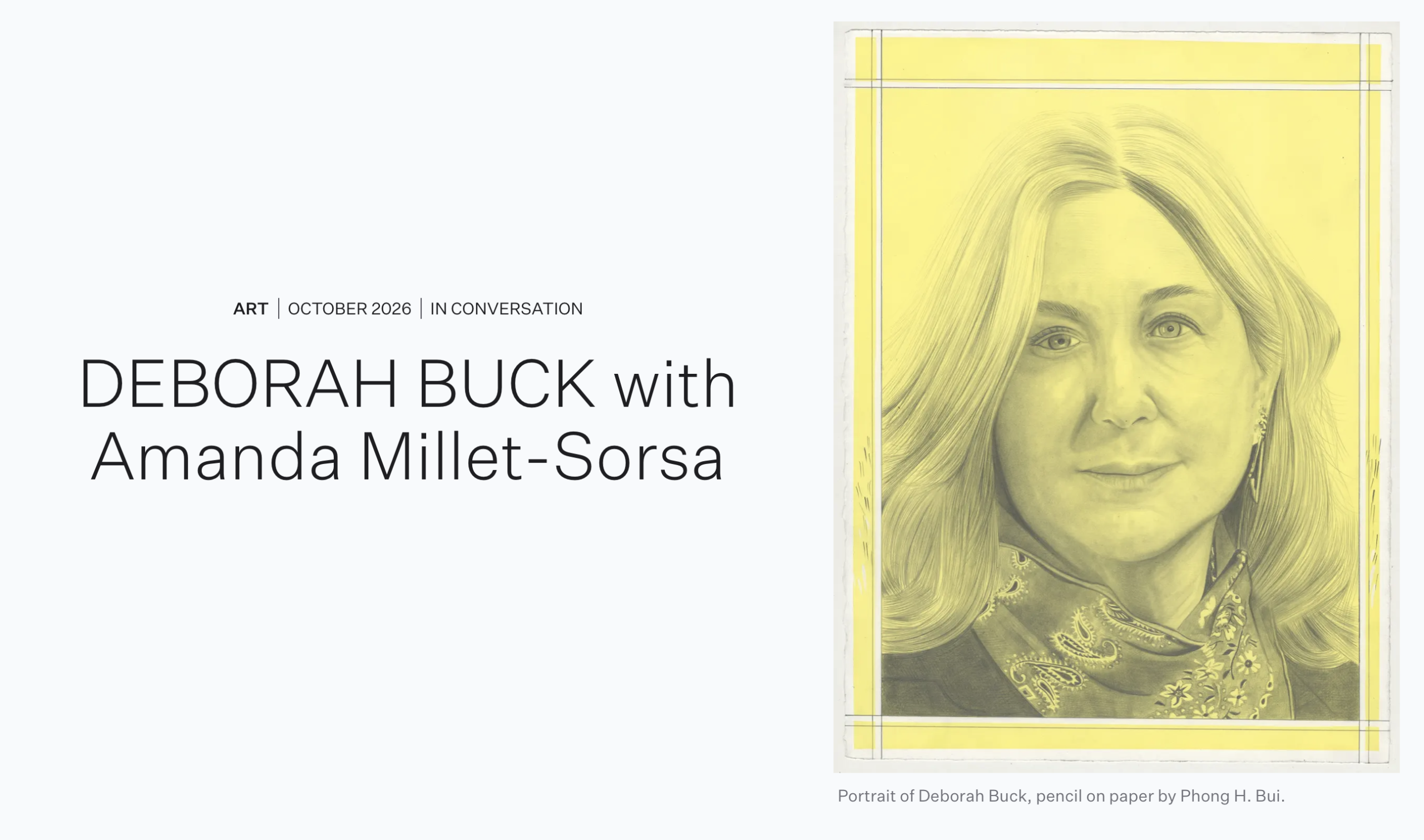
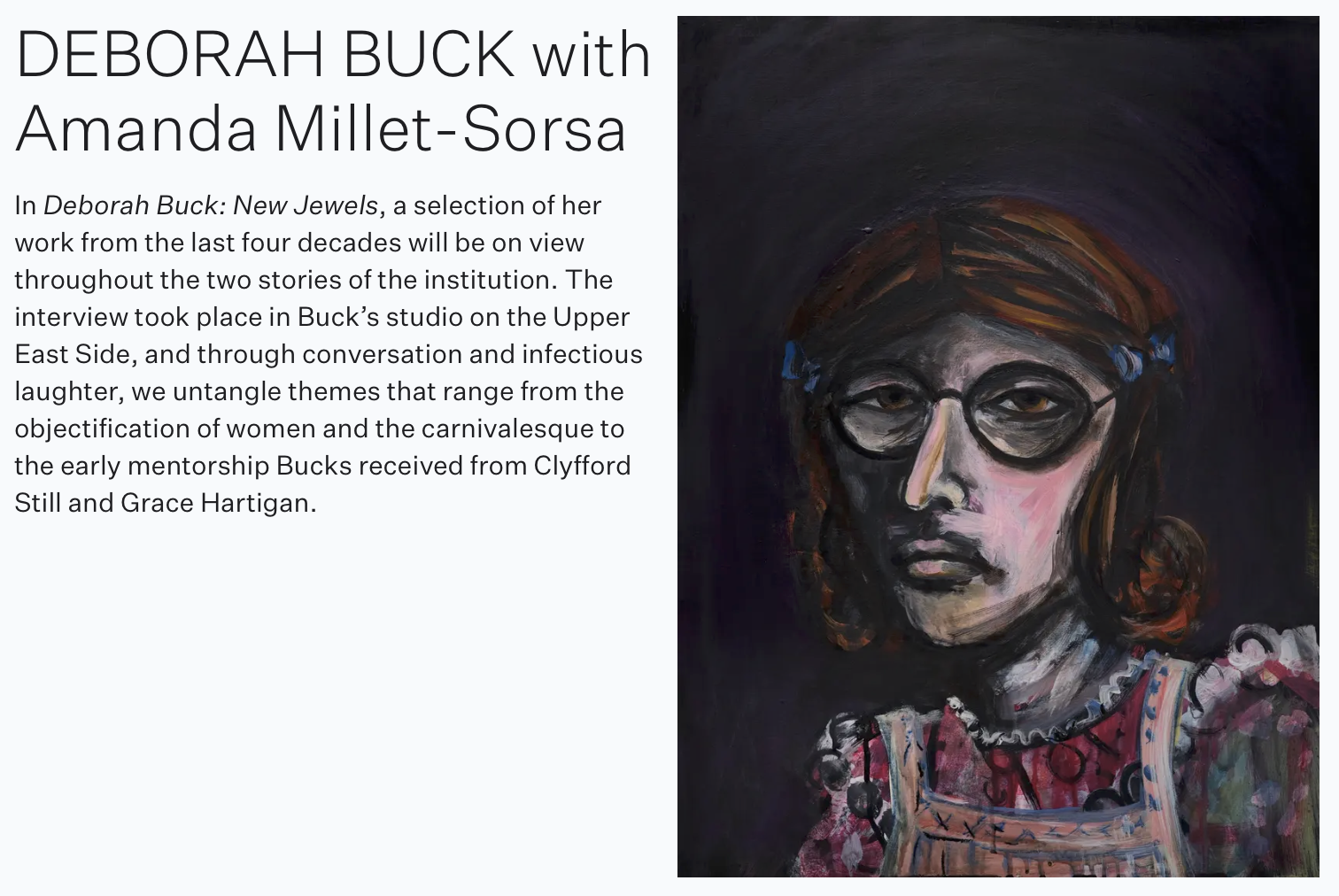
Pen + Brush is an arts center over 130 years old, located in Flatiron, and will be showcasing over forty artworks for the retrospective of artist Deborah Buck, curated by Summer Guthery. Both the artist and the institution share a joint commitment to supporting the work of women, non-binary, and female-identified transgender artists. In Deborah Buck: New Jewels, a selection of her work from the last four decades will be on view throughout the two stories of the institution. The interview took place in Buck’s studio on the Upper East Side, and through conversation and infectious laughter, we untangle themes that range from the objectification of women, the carnivalesque, fairy tales, humor, and Buck’s roots in Baltimore to the early mentorship she received from Clyfford Still and Grace Hartigan.
Amanda Millet-Sorsa (Rail): Where were you in the 1980s when you were ready to be on your own and painting? What were you responding to? What was resonating?
Deborah Buck: I was living in Baltimore where my family was from after college. I felt women were having to fight even harder for their place. I was in my twenties and I had a lot of female friends who were very busy getting married and having children, and I couldn’t relate. I was passionate about being an artist and a painter and being able to have my vision seen by the world, and I felt as though women were sidelined—which they still are. In the 1970s, Judy Chicago, Linda Benglis, and all these women were beginning to make waves within the male pool of contemporary artists, and then Mary Boone and her group of gallery guys began the Neo-Expressionist work in the 1980s, and all of a sudden it was an all-boy show again.
Rail: Did anything about Neo-Expressionism resonate with you?
Buck: Having gone to school in the 1970s—which was very focused on Minimalism and Conceptual art—I wanted my work to be about the paint itself. I had all these abstract paintings I’d been doing in school and in my studio, and I thought, “I don’t know how to paint the figure, but I like what they’re doing.” I have always wanted to be expressive in my work—outrageously so. I started bringing models into my studio to paint and draw. By the 1980s and ’90s, I knew I was making paintings that were fierce and that there were some role models.
Rail: Who were the role models?
Buck: Grace Hartigan lived right up the street from my studio. She would come and yell up to my window, and I’d throw the keys down, and we’d go have a cup of coffee. She was just how you think she’d be: irreverent, ballsy, smart as hell, and sarcastic.
Rail: What did she transmit to you?
Buck: I was honored that she even wanted to have a cup of coffee with me. I was absolutely thrilled that she wanted to see what I was doing, so I felt like that was a tap from the universe.
Rail: What do you think she taught you?
Buck: She was so independent, and she never stopped, no matter what. Her work changed a great deal, and she actually made figurative work in the 1980s, which didn’t land with the public as easily as her Abstract Expressionist work from the 1950s and ’60s. She was pursuing what she thought was fascinating.
Rail: What struck you about her independence?
Buck: These figurative works that she started to do were inspired by the really crazy odd window displays with mannequins in Baltimore—especially in the area where her studio was and where my studio was. There were all these wedding and bridesmaid stores with cheap veils, bright colors, and over-the-top designs for your big day. She was painting about those, and also about fairy tales: King Arthur, that kind of thing. They’re told to children as a way to teach, and also lots of those stories reinforce the roles of men and women—that men are kings and women are queens who produce heirs—and so all of those messages felt encoded in all of those books and stories that I was reading. It was trying to teach me about the world and how it works.
Rail: You had another incredible role model in a neighbor of yours: Clyfford Still. You corresponded with him late into his life, and he sent you on a scholarship in his name to Skowhegan, Maine. He taught you how to think and observe the world.
Buck: He would sit me down and tell me: “Nobody can teach you how to paint. You already know how to paint.” I was sixteen, and here’s this man who’s a great artist sitting in front of me. Remember, there’s no internet, so all I knew about him before I met him was what was in H.W. Janson’s art history books—and there were no women in Janson’s art history.
Rail: How lucky to have him as a neighbor near your childhood farm. How did you respond to his work, which is so vastly different from what you’re doing in the 1980s?
Buck: I thought it was so powerful. To this day, I can sit in a room of Clyfford Stills in awe of the power that he exhibited through painting, and the integrity of his practice, which was rigorous and beautiful. I take it as an honor that he wanted to help me as an artist. He died too soon. I was bereft at his funeral, and attended his retrospective at the Metropolitan Museum just the year before. To this day, his words really resonate. It’s about being true to yourself, to your work, and making the paintings—keep learning and keep growing.
It’s why I’m really excited about New Jewels, because it allows me to think about my paintings as a whole body of work. My work has changed a great deal over time, but I think the spirit is the same. There’s the same sort of rebelliousness, the fierceness, the not being afraid, not trying to please. I try to teach myself something every day that I’m painting, and to find something new that will resonate with me, and hopefully with the rest of the world.
Rail: Speaking of “outrageously” expressive: some of the first works that we see when we enter your retrospective are the series of works that you call the “Bad Girls,” which are scary and lush and outrageous themselves. Can you tell me a little bit more about where the ideas came from?
Buck: I think we could call them the Furies, because they are beauty queens, or women in predictable roles, clothes, hair, and jewelry—all of the trappings. The show is called New Jewels. The poster girl of the show is wearing a crown and big gold baubles and a necklace and bracelet, and they’re sparkly and gold. It occurred to me that you get rewarded with jewelry as a woman for agreeing to marry a man, having a child, and then it becomes part of the objectification of a woman. You lose your commodity which is most valued—your looks and your face—and your husband becomes more successful, and you’re given all this jewelry, most of which is really ugly. [Laughter]
Then there’s number two: the runner-up in a beauty pageant. The pageants became a symbol for what I didn’t understand. Why did women who were clearly smart, talented, and ambitious enter beauty pageants? Because it’s a place where women could actually be recognized, but you have to be deathly thin, with a symmetrical face—and why do you have to be lily-white? [Laughter] I was constantly reminded of how narrow the field was for women. I was lucky I had people who wanted to show my work, that I had a platform in my twenties and the 1980s, and up until now. I truly paint from my guts and my heart, and from my experience as a woman.
Rail: Was this something that you were discussing with your peers, with other women?
Buck: I certainly would speak about all these things when people visited my studio. There were always shocked looks, which I thought was good. I never wanted to just make pretty pictures or well-constructed pictures. I wanted to let my brain be the driver: What was I fussing about? What was I preoccupied by?
Rail: Of this group of paintings, which one is the most outrageous?
Buck: I think they’re all outrageous. [Laughter] Especially the ones that have a skeletal face—they scare even me. You know, they scared me when I made them, but I was compelled to make them because if I had to give up my work, I would die. To just become a wife and a mother—and I know this is sacrilegious—was death, and to be put in a box was death, and so I think that’s what I was wrestling with. For instance, The Hostess (2025), that woman who lives to throw parties. I love a good party, and I throw a pretty good party, but it’s not my job, it’s not my world, it’s not my life.
Rail: Have you embodied any one of those “Bad Girls?” Have you been in that role of the hostess and questioned what that is? Or been the recipient of jewels—been valued for your aesthetic?
Buck: I was married, I had a child, and I really didn’t understand the bride obsession. I thought that was just another costume, and that’s probably where the New Jewels painting came from. I didn’t understand why I had to have this diamond to mark that I loved someone, and that I would continue to love them. Why did we have to do this whole thing where I was put into yet another costume, and I lost my name? I’m very aware of social and historical rituals that man creates to make life easier or more understandable. Sometimes it makes things harder for women, and so I was interested in talking about all those things through my painting.
Rail: You have a fascination with fairy tales—with the Brothers Grimm and Hans Christian Andersen—and you worked at Disney. How did you develop those interests?
Buck: What I love about fairy tales and children’s stories is that they’re about absurdity and transformations. People are turning into animals, animals are turning into people, the good witch turns into the bad witch, animals speak, animals have power, they wear crowns—all of those things. I grew up on a farm, and as a young girl, I spent a lot of time alone in nature, wandering around. I always wished the animals could talk. When I read these stories, they were all talking.
Rail: Was there a specific story or tale that remained with you?
Buck: I made paper puppets of all the characters in The Wind in the Willows one summer when I wasn’t in school. I really loved them all, and I understood that there was a darkness, which I found exciting.
Rail: What was the darkness about?
Buck: There’s always a witch—and of course it’s a woman! Sleeping Beauty dies, but then comes back to life. I thought that all of these stories were teaching me much more than church was, but they have a lot of the same themes, like resurrection and transformation. Certainly women transform from small girls, to adults, to mothers, during and after pregnancy, and then to an old crone, which is when you’re not valuable at all, unless you become a witch. [Laughter]
Rail: That’s the full circle. [Laughter]
Buck: I can vividly remember sitting by a stream and a frog jumping out, and me thinking, “I wonder if that’s the frog prince. Why can’t he talk?” I wish he’d just say, “Hi, Deb, how are you?”
Rail: What was it about the animals having the ability to transform that was appealing to you?
Buck: They were empowered. They had a voice. As a woman, to use my voice and to say, you know, I want more. This is not okay. I don’t want to be a cookie-cutter woman. I want to do more than what’s expected of me.
Rail: Was there a point where you became cognizant of this desire?
Buck: I think I always believed in what I could do as an artist, and I knew that I was very different because of that. I had power. Now, it was frequently misinterpreted and misunderstood, but I think I was aware of the power that I had from it. I began drawing and painting when I was young.
Rail: It’s interesting because women have always engaged in some kind of visual activity. I imagine the Victorian living rooms and women embroidering and painting flowers, so women have always had that available to them. Yet there’s something interesting about what you’re saying—that the act of drawing in a society that doesn’t give women a voice already gives you already something to work with, and the possibility for empowerment. As you have been reflecting on your life’s work, what have you observed about your painting or recurring themes?
Buck: Absurdity—even in portraits, because they’re not real people. I find them while I’m painting. I don’t know who they’re going to be when I start. There’s no reason why someone can’t be wearing a crown in a bar. She feels like she’s wearing a crown that day. You make it up.
Rail: In New York, that could be someone’s reality, and you could see that every day. What is it about the absurd and the surreal?
Buck: For instance, in Shootout at Sunset (2026), there’s a rabbit having a shootout with a pig. There are attributes we place on the rabbit, who is thought of as more kind than the pig, so he’s the sheriff, for instance, because we think of pigs as being dirty and disgusting—
Rail: It’s a reverse role-play?
Buck: [Laughs] Yeah, and they’ve got guns. I hate guns, and I hate what guns do in the world. But bullets are flying, and they’re these animals who are like people, and the flowers have faces—absurdity. The collages and murals have let me really indulge my sense of absurdity. Could a teacup fly through the sky? Why not? I got a teacup from an old painting, then cut that out, and placed it in the sky.
Rail: In the show we have a counterbalance between your early work from the 1980s, this group of “Bad Girls,” and your last twenty years of work encompassing this narrative, absurd world of characters. This later part of your work has the absurd in motion, with many different characters, environments, and places, compared to the single figure, the outrageous woman of the 1980s. Is this something you’ve observed, as you’ve looked back at your work? At what point did that shift occur?
Buck: I’m very nearsighted, and I have no depth perception, so I don’t see the world with backgrounds. I’m always very focused on the frontal figure, so I think that’s part of my world vision, which meant I wasn’t really concerned with backgrounds. I was interested in people, figures, stories, animals. With the collages, I began thinking, “Where do I want this to be? I’m going to create a scene, like a set,” so this came to me. “I want to put something in the desert, out West in America like an old Western movie, but with my funny characters.” I painted this backdrop of a sunset and the masses, and then began cutting out the figures from paintings that I felt were unresolved. The pig and the rabbit come from two very different paintings, as does all of the vegetation. The hat comes from a whole different character. The vegetation comes from an underwater painting, but they all find their place here, and I figured out how to incorporate where the figures are, so that’s a big resolution for me.
Rail: Do these settings come from travels? It feels very Western, with a messy American-ness—guns shooting all over the place without social order. One’s a sheriff, one’s a cowboy with coyotes nearby.
Buck: I suppose that they are American tropes. The Southwest, the cowboy movies, Mother Goose. Usually we think of Mother Goose as being kind, but she’s pissed off here, and Humpty Dumpty is just a mess, and so I like to take all of these things that are givens and turn them on their head. You know, what happens if the man on the moon is wearing sunglasses? What happens if the three blind mice really aren’t blind? It’s rewriting all of these childhood givens.
Rail: Disney makes me so mad. [Laughs] It sounds as though these stories that were part of your childhood—you’re taking them one by one, and putting them in a big, jumbled-up collage. What’s the impetus behind that for you?
Buck: I think that’s what my life has been—just really absurd. I’ve lived all over the place, and I’ve gone all over the place. The people who I met as a young person—none of that really should have happened. Then there was a lot of tragedy in my family, and part of that is the dark side of fairy tales that you see in my work, and the sense that anything can happen. Just because we’re sitting here today doesn’t mean that we’re going to be here tomorrow. In my life, my family, people have come and gone when you least expected it. So I think I have a very deep understanding of how precious it is to live in the moment, to be open to whatever could possibly happen, and to be able to enjoy the absurdity of things. [Laughs]
Rail: To laugh at it! Humor is a big part of who you are—you can see it in your work, and these works of yours are much more humorous than any Mother Goose tale I’ve ever read. Some of those can be quite serious.
Buck: They are lecturing.
Rail: They make you take hold of lessons, so you’re supposed to be on your guard: your choices have consequences. When you jumble it up, you’re also questioning the lessons they convey and what we’re supposed to take away, and questioning if the meaning has been lost. You’re using a lot of satire and humor, in how the characters look and the way you’re outlining them with this black contour. What has humor revealed to you?
Buck: There’s this sense of the mischievous. I think my humor is baked in the bone as a coping mechanism, and I use humor for something I think is unfair or needs to be addressed.
Rail: We can see that in the “Bad Girls”—who are these women? Why is the accentuation on jewels, makeup, or a mask?
Buck: Aren’t we all wearing masks? Knowing when to put your mask on and when to take it off is valuable, and it’s part of being evolved, growing, and protecting yourself. As a woman, you have to protect yourself from judgment, from stereotypes, from lack of agency.
Rail: Can masks also empower?
Buck: The Lone Ranger, Batman—those characters wear masks because they have more power with the mask on, and I think makeup is a mask. I painted lots of women from the 1980s in the “Bad Girls” series with red lipstick and huge hair. The hair almost becomes a construction of itself, like with the beehive hairdo.
Rail: Rainer Maria Rilke wrote in The Notebooks of Malte Laurids Brigge: “There are quantities of human beings, but there are many more faces, for each person has several.” I’d like to know more about the carnivalesque throughline in your work. Have you ever been to a carnival?
Buck: I love costumes. It’s a way of slipping into different identities. There were always carnivals in the country in the summertime. The people were a little scary. There were rollercoaster rides, bright lights, and clowns. So those dichotomies are fascinating to me, and I think that you paint what keeps resonating through your life, and I feel as though these figures, these characters, are gifts.
Rail: Since those carnival experiences in your childhood, have you had ones that have marked you as an adult—either the big festive ones that are ritual-based, or ones from county fairs elsewhere, or even Halloween?
Buck: I’m drawn to James Ensor’s work that features those kinds of carnivalesque images. Baltimore is one big carnival, and I spent ten years painting in Baltimore after school painting. John Waters and his characters—I mean, they were in and out of my life. A lot of the people in Baltimore have bravura. It’s the biggest goddamn beehive hairdo you have ever seen in your life! [Laughs] It’s on a woman who is a hundred pounds overweight and she doesn’t care, and she might even just be wearing her bra as her shirt, and it’s part of this lowbrow badge. I spent a lot of time in that world since my studio was down by the wharf, where there were a lot of outrageously colorful characters, and they’ve always been part of my core. They seem to possess a certain joy in just being who they are; they’re not hiding. They have the conviction of who they believe themselves to be and just flaunt a tutu at two o’clock on Saturday afternoon, because they feel like it! It’s close to a childlike rebellion.
Rail: What is the appeal?
Buck: Freedom, freedom, freedom—to be who you want to be, how you want to be, when you want to be. The creative part of me was nurtured, but I’m actually quite rebellious in my own way, and I want to question everything.
Rail: On one hand, the carnival and how you’re describing this environment in Baltimore, there is a freedom to be exactly who you are—but in the carnival, with all of its costumes and masks, it also hides who you might be. There is an innocence to the child’s pranks and laughter, but when you become more mature, suddenly some of that laughter can become rather wicked.
Another point about your work that you’ve made in the past is that, as a result of going through these dichotomies of the carnival—of the masks, of the hiding, of the revealing—there’s a sense of optimism that you want to convey in your work.
Buck: There were a lot of artists who used the carnivalesque, but they were deeply depressed. I use it as a way of making the world lighter, because I see huge problems in the world, and I think right now I’m terrified at the vulgarity and the violence and the lack of respect for our shared humanity. I’ve always been frightened by what man can do, using war. It’s an underlying energy in my life, and my work allows an outlet for what I am afraid of. For instance, in Ambivalent Monarch (2026), she’s wearing a crown, and there is a reference to symbols of power: crowns, scepters, capes, all of those things.
Rail: Are there works in your show that address vulgarity and violence?
Buck: Shootout At Sunset. Women are asked to play roles in costumes that they’re put in for beauty pageants, or dress in of their own volition—wearing, you know, negligees on the street, and objectifying themselves—because they’ve been told that’s how they will gain respect or admiration from men, rather than say, “I don’t feel comfortable.” I have a pretty good understanding about how harsh reality is and can be, and about the dark side of humankind. I think you know that we are lucky that we’ve gotten this far, because the world has always been terrifying, and that’s why I’m fascinated by knights, kings, and queens and all: because it was terrifying. I mean, what a horrible time to be alive, and yet all those people found joy.
Rail: So I wanted to speak a little bit about your process. You described your process as being highly intuitive and a bit of a treasure hunt: that the way you start, you don’t quite know what you’re going to find.
Buck: I think that I’m trying to speak to, like, the everywoman, the everyman, the universals, and not all in one portrait, but in things that I’ve glimpsed about humankind, in looking at faces. I’m looking for who are you, who are we, and they’re all an amalgamation of all the faces I’ve studied all my life—on the street, the subway, the airplane, at parties. I want to discover a new person when I’m doing the portraits.
Rail: What have you glimpsed?
Buck: The fragility of human beings. The fear, humor, and laughter—the ability to break character. I love to see the façade fall, and I think that the portraits are all about hopes and fears, and the toll that life takes on a human, and how it’s etched on a face.
In The Farmer’s Daughter (2025), the painting started as a woman, and then I started thinking about farm women that wear these aprons. I put an apron on her, and I thought, “She’s the daughter of the farmer,” but as I painted, she just started looking more masculine, while wearing this apron, and she’s growing a beard, and finally I thought, “She’s not sure. I’m gonna let this character that I found while painting, just be.”
Rail: How do you make choices about color?
Buck: My sense of color has never changed and has been the same for forty years, and it is high-intensity. I’m always trying to get the most out of every color, and to yell—I want it loud. I’m not going to get anywhere being quiet, and that’s part of my personality, not whispering.
Rail: These are high-volume paintings! Today you have a foundation dedicated to supporting women in the arts with the Deborah Buck Foundation, which means you are a practicing artist engaged in philanthropy, making you a multifaceted individual. In addition to pursuing painting that addresses questions about women, how has engaging in the world through this philanthropic mission added to your practice as an artist?
Buck: It was very fulfilling to realize I had the guts to do this. At the end of the day, I can sleep because I will have made a difference in opening people’s eyes to what has not been allowed for women. These works are very controversial and sort of shocking in their own way, and yet if a man had made these paintings, they’d be considered raucous—sexy even. Today there are a lot of women making outrageous paintings. But we haven’t gone far enough, so my foundation will go on after I’m dead. When I take my final breath, I can feel proud about that.
Rail: Could you share more specifically how your foundation has made an impact?
Buck: I only support institutions. I think in order to really create change, you have to do it at the institutional level. So when an institution says work is important and needs to be seen, and it’s by a woman that hasn’t gotten her due—if the work is forceful, outrageous, strong, and brilliant, it needs to be shown, and I say, “Okay, let’s go!”
Rail: An artist who also has the capacity to be a philanthropist—it’s a special role to be in. You have to be brave. Gertrude Vanderbilt Whitney comes to mind: she founded of the Whitney Museum, and also had an active studio practice. More recently, Tony Bechara was a painter (currently being shown at the Parrish Art Museum in Water Mill, New York) who was also on many boards and engaged in nonprofit arts philanthropy. J. Seward Johnson Jr. was a trompe l’oeil sculptor and founded the Grounds For Sculpture park in New Jersey. Through the Rebuild Foundation, Theaster Gates combines his practice as an artist with initiatives to create impact in South Chicago neighborhoods. There are more and more artists whose practice intertwines with philanthropic missions. Your foundation’s mission to support women in the arts, where there is an imbalance, has accompanied questions you’ve studied and put out there your whole career.
Buck: I can only hope to be included in that really lovely pantheon.
Contributor
Amanda Millet-Sorsa
Amanda Millet-Sorsa is an artist and contributor to the Brooklyn Rail.
Leave a Reply